A quick overview on the trauma discourse
The experience of undergoing psychological trauma is deeply chaotic – the agony and damage skew the person’s senses and understanding of the world and relationships. When it comes to healing, self-understanding, externalizing the pain and describing the feelings are of crucial importance, but the process is often difficult and takes a lot of time and sometimes due to the overwhelming nature of the emotions, it blocks the closed ones outside and they may not fully understand the whole situation. And for some reason society tends to simplify pain, depicting healing as linear and uplifting, romanticizing / sugarcoating pain, and intellectualizing the situation (think clients’ stories reduced to overly clinical case studies, the saying ‘everything happens for a reason’, the portrayal of depression in pop culture etc.), which makes personal healing more difficult and the survivors more pressured.
Raison d'etre of the zine
The Traum(a)’s Kunstkammer emerges from a trio of stimuli: the contemporary discourse on trauma, firsthand observations within mental health spheres, and a series of random unsettling still-life drawings. This leads to the core question: can trauma and its symptoms be visualized through a structured yet accessible framework – one that avoids sugarcoating and intellectualization, while honoring the survivor’s endured pain? And this is how the zine unfolds. This illustration zine is a dark collection of 12 entities presented in the form of kunstkammer, the European chambers showcasing unusual natural and artificial objects in the Renaissance. Each object symbolizes a simplified stage of trauma’s life cycle, demanding readers to face the ruthlessness of how trauma reshapes one’s mental state and life.
Formation of narrative
The project originated as a series of eerie surrealist still life illustrations. This form, however, risked being perceived as an idiosyncratic expression, lacking transferable resonance. The requirement for a robust, transferable narrative structure thus became crucial. The medium shifted to a zine format, which demands a connective thread. The research process started, which identified the Kunstkammer (cabinet of curiosities) – a 16th-century precursor to modern museums for displaying unusual objects without judgment — as the optimal conceptual container. Its selection is justified by 2 structural correspondences: 1) the non-judgmental display logic directly mirrors the project’s aim to present trauma’s core without minimization; 2) its ethos of direct confrontation counters the prevailing narrative of enforced positivity in healing.
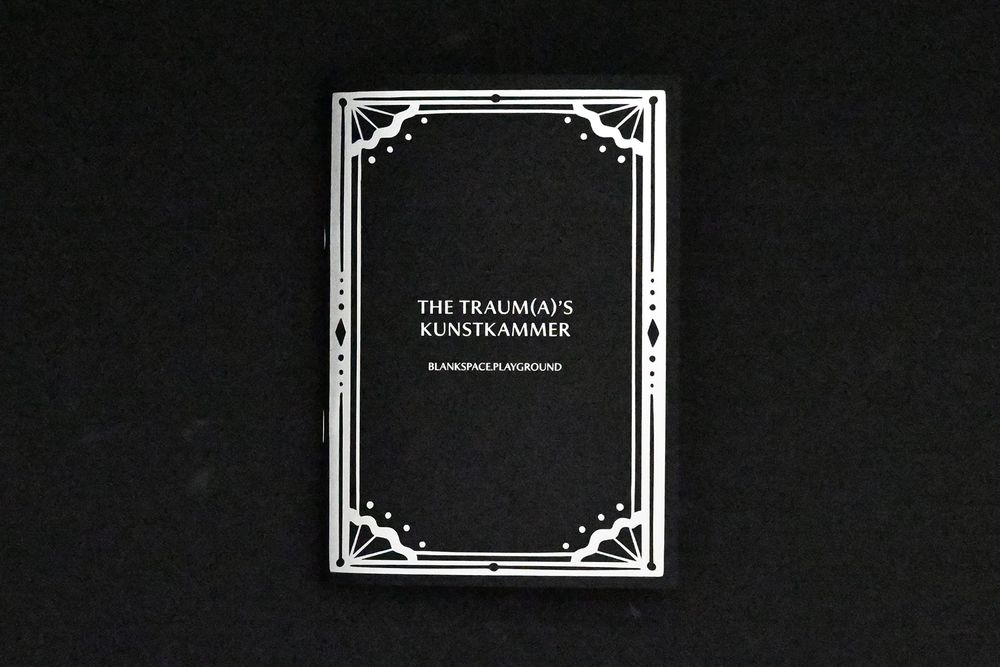
The zine is titled the traum(a)’s kunstkammer, which is a bilingual word play – traum (‘dream’ in German) indicates the surreal, imaginative nature of the zine and the fact that trauma can’t be solely reconciled to with logic and rationality, and trauma (‘emotional response caused by strongly distressing events’ in English) is the main theme.
Building the story and supporting visual / verbal system
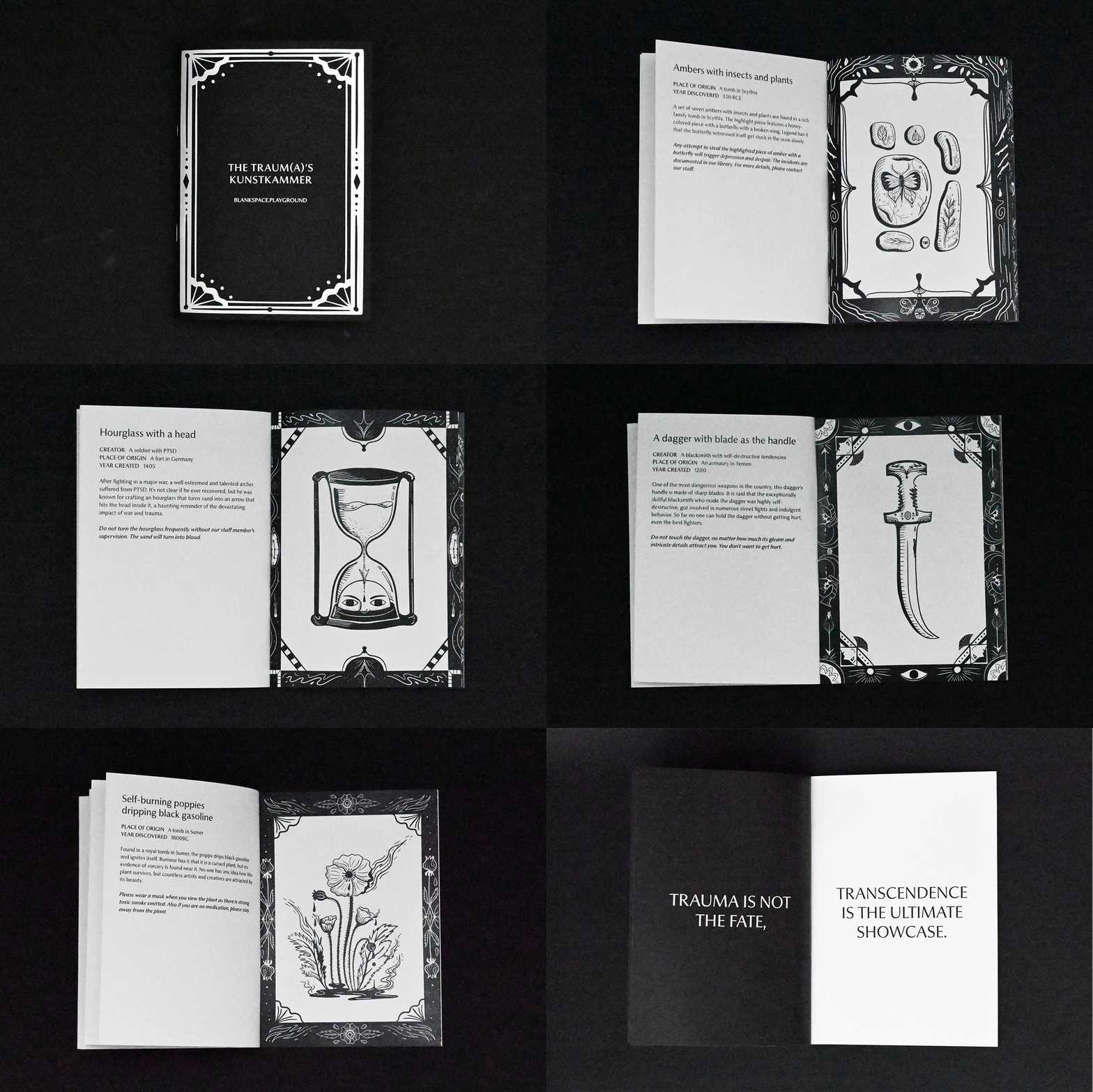
To realize the idea and utilize the concept, the zine is presented as a museum pamphlet of the imaginary showcase. A three-act framework that echoes trauma's life cycle / various stages is adopted, though simplified (recovery isn’t a linear process): 1) the happening of trauma (includes 3 objects, 2) the aftermath and disorder (includes 6 objects, and 3) realization and healing (includes 3 objects). 12 objects are created, from intricate craft objects, physics demonstration devices, to surreal plants and remains of animals, to mimic the diversity of the collection of a cabinet of curiosities.
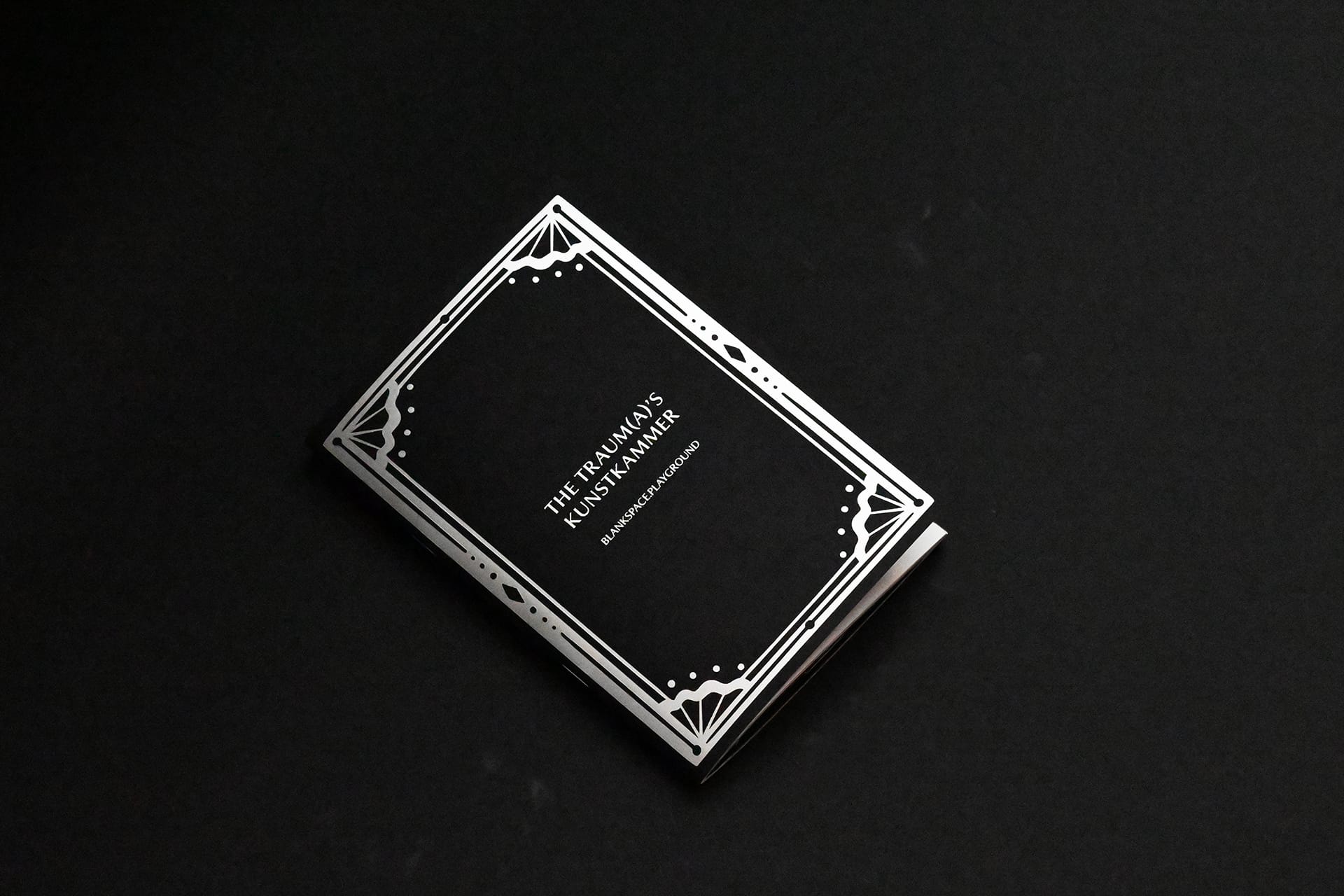
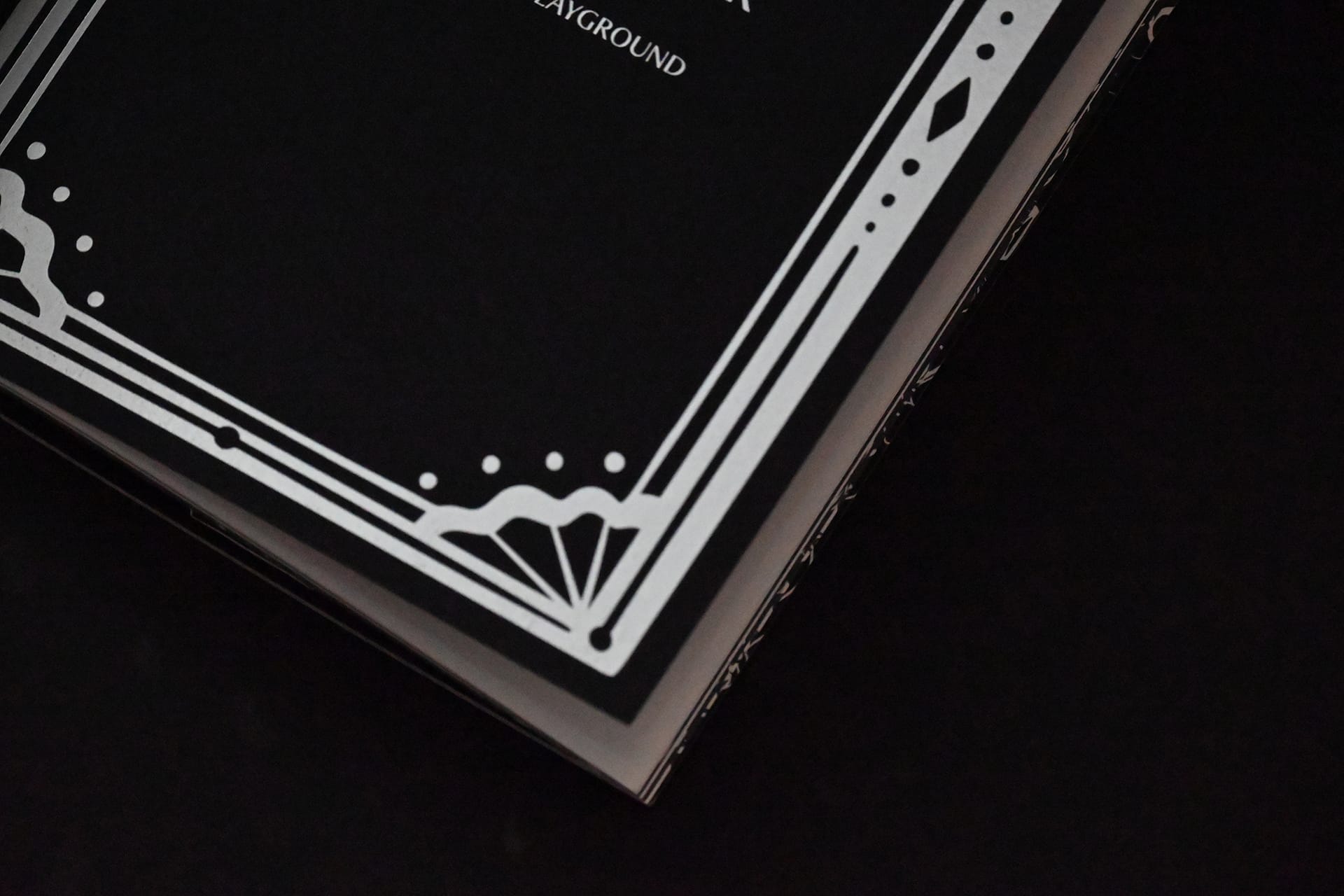
In terms of visual language, clean, detailed surreal black and white illustrations with intricate borders and white background are created, which lets readers focus on the characteristics of the object and mirrors the setting of museum exhibits, while the borders serve more than decorative purpose; they provide extra information of the object, like background and how it’s used, and narratives / plots developed around the entities. The typographic choices are kept simple to let the images speak and follow the format of the exhibition leaflet. PP Museum from Pangram Pangram is used for its modern elegance with a humanistic touch. Silver foil print is used in black cover pages, adding a touch of luxury that echoes with the established socioeconomic nature of the historic cabinets of curiosities.
The text plays an integral part in the storytelling. Each object is accompanied with museum pamphlet-like blurb, which includes the following: 1) the maker (only the occupation is shown; applicable to artifacts); 2) place of origin; 3) the year of creation / discovery; 4) description (a mix of historical facts and made-up lore); 5) warning to the viewers (the consequence of interacting with the objects). The text includes dark, dry humour with a touch of imagination, but is written in clinical coldness and a factual manner. The intense contrast of the absurd content, cold tone of voice, and the fiery anguish is designed to make readers uncomfortable and immerse in the world where logic distorts, perception is challenged and only feelings make sense. At the end of the zine, a manifesto-like sentence 'trauma is not the fate, transcendence is the ultimate showcase', is displayed to show readers that trauma is never the end, there’s a way to defy the harm and there’s no need to sugarcoat / intellectualize the devastation.
The symbolism of 12 objects, explained
Chapter 1
The first chapter (happening of trauma) is presented in 3 objects, a clock, a collection of ambers, and a Galileo thermometer:
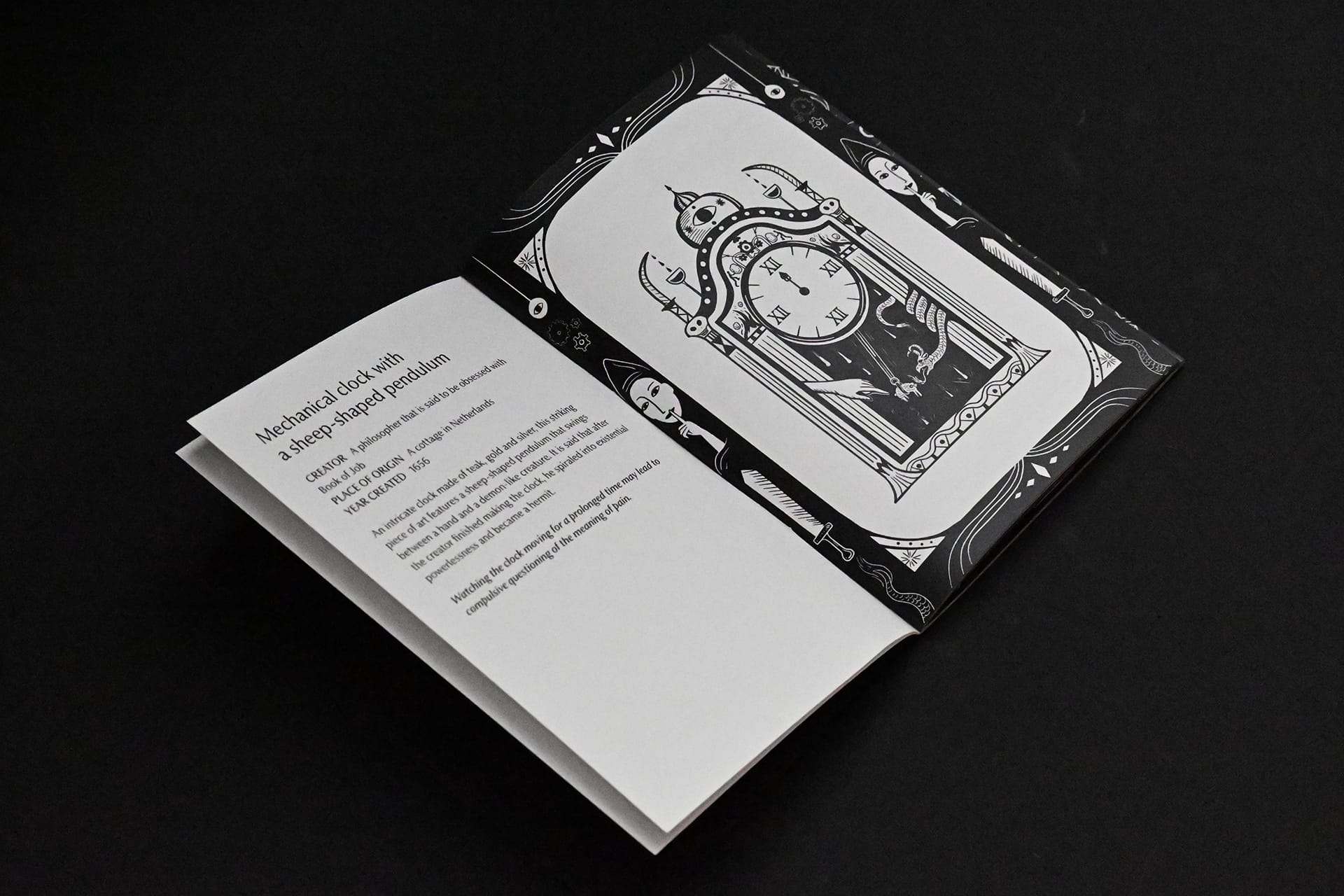
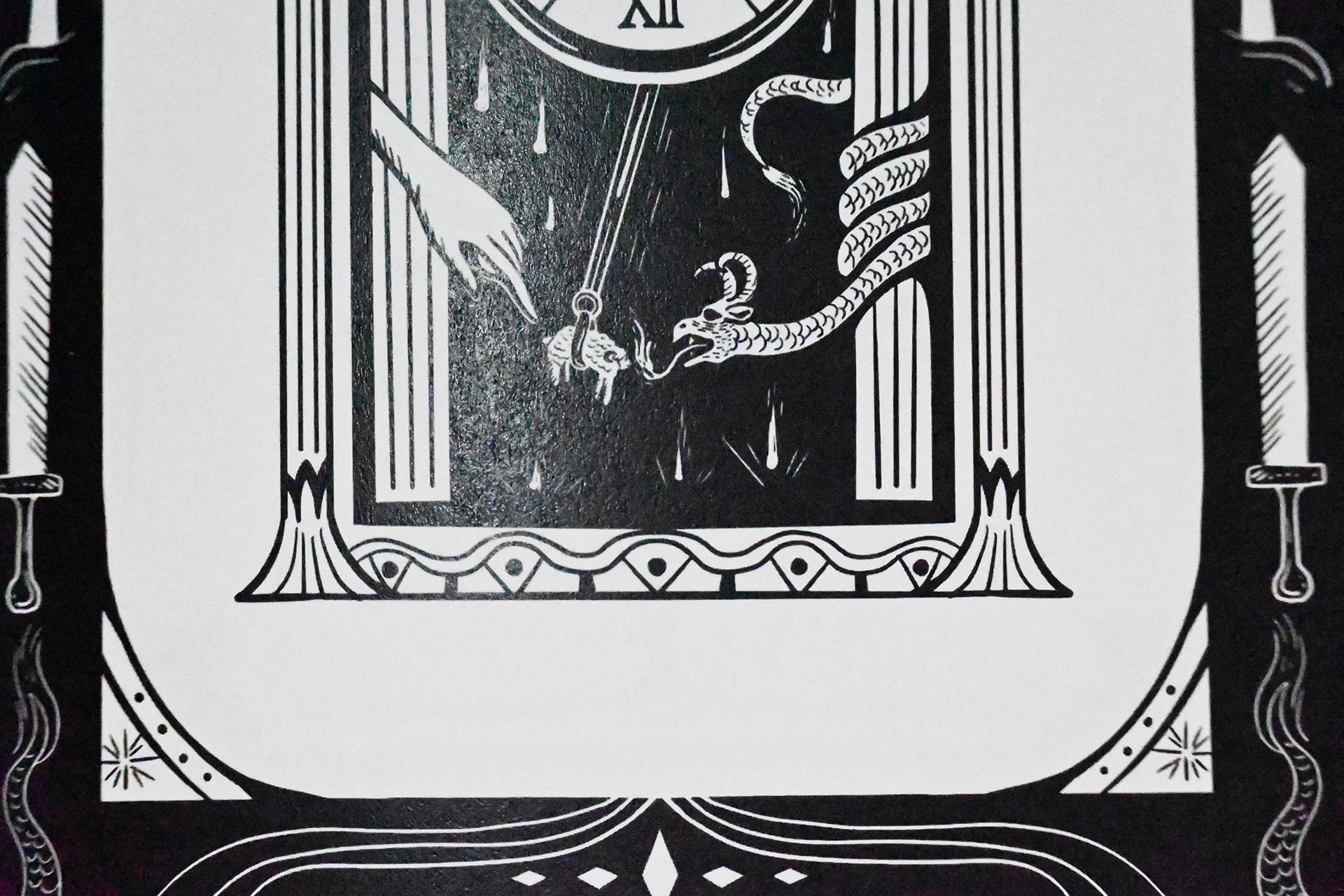
Mechanical clock
this antique clock has a sheep-shaped pendulum that swings between a hand and a demon-like creature. All the intervals of time are marked with the number ‘12’. This represents the innocence of the victim, a chance and devastating event(s) / abuser(s) has done harm to them. The victim is trapped in the event / harm and couldn’t find a way to escape from it. Created by a philosopher which is obsessed with Book of Job, it is a direct question on whether suffering has any inherent meaning, and why there needs to be justification of pain endured.
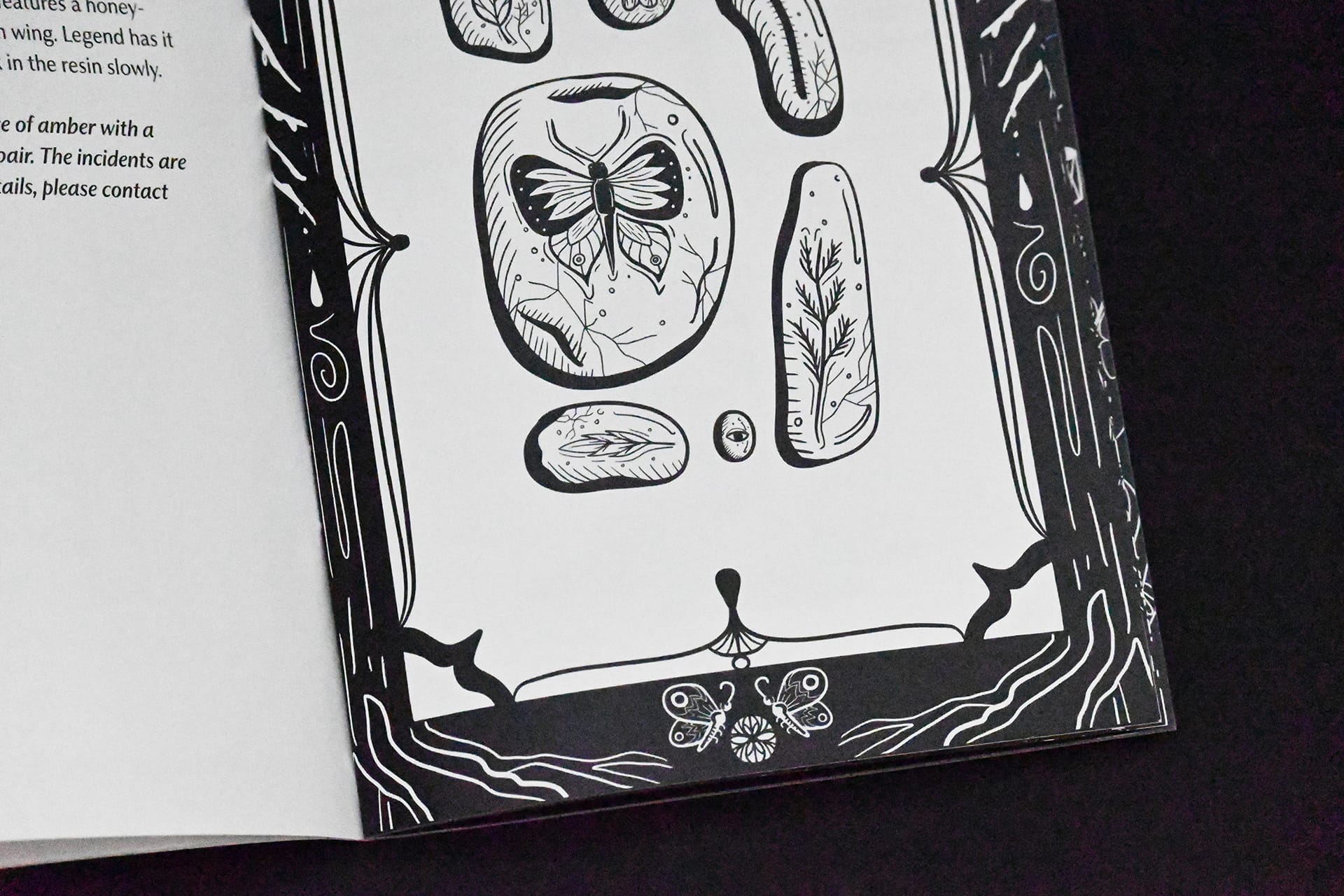
Ambers with insects and plants
this is a set of ambers. The highlight of the amber pieces is the one with a butterfly with a broken wing, which means the victim is trapped in sadness and pain, and can't find a way out for the time being.
Self-burning Galileo thermometer
the device originally measures temperature by the density of the liquid in the bulbs of a sealed glass tube. However, designed by a Catholic monk with bipolar 1 disorder, this version burns itself and fails to measure the temperature, representing the bottled manic / fiery anger of the victim.
Chapter 2
The second chapter (aftermath of trauma, associated mood disorder) is presented in 6 objects, a hourglass with a head, a newton’s cradle made of bombs, a nautilus shell with mouths, a metronome, a dagger, and a potted plant that sprouts eagles:
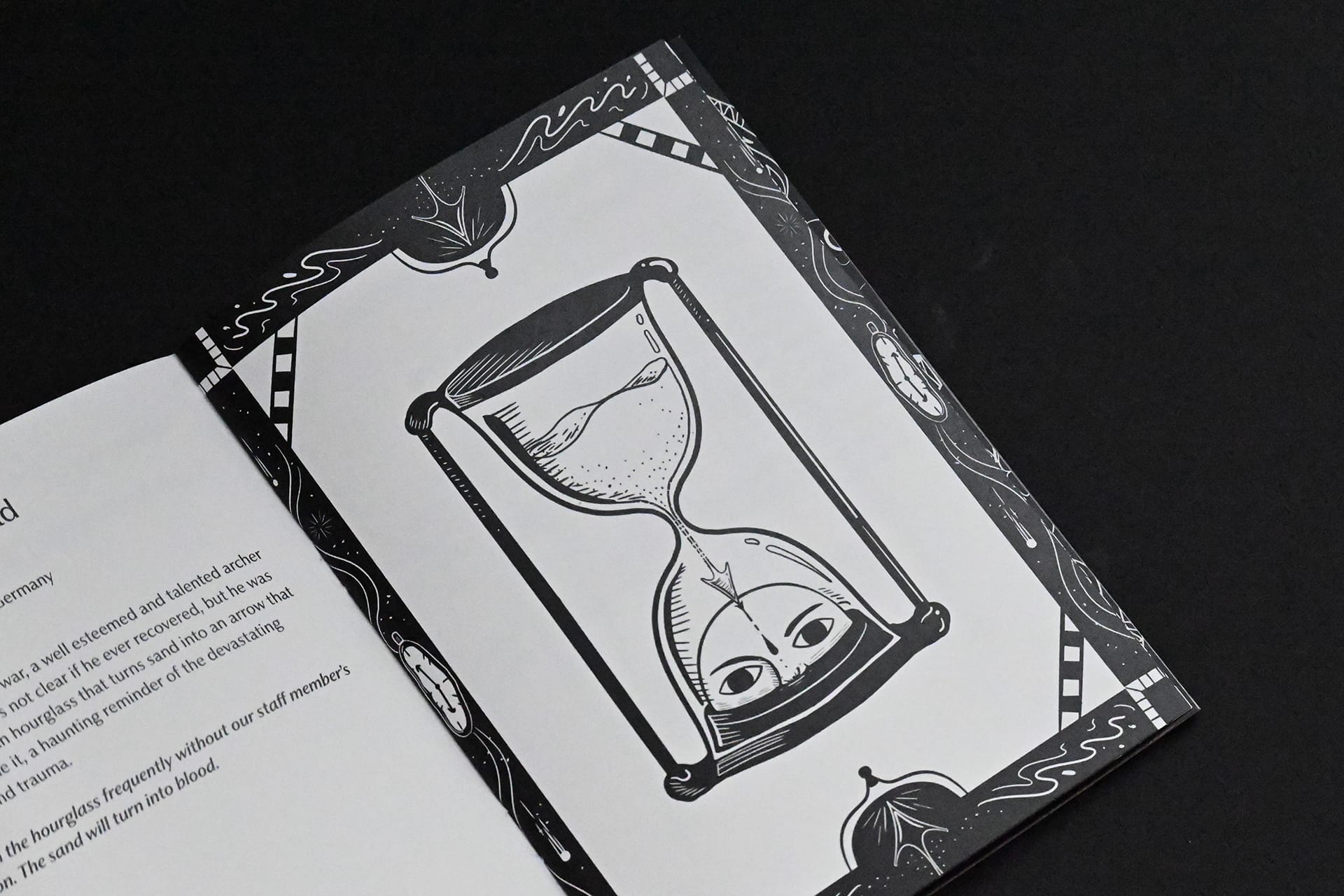
Hourglass with a head
designed by a soldier with PTSD, the base of the hourglass is a head, and the stream of sand turns to an arrow that hits the base. It defies the conventional notion that time heals wounds, implying that without proper treatment / intervention, the trauma will inflict more harm as times go by.
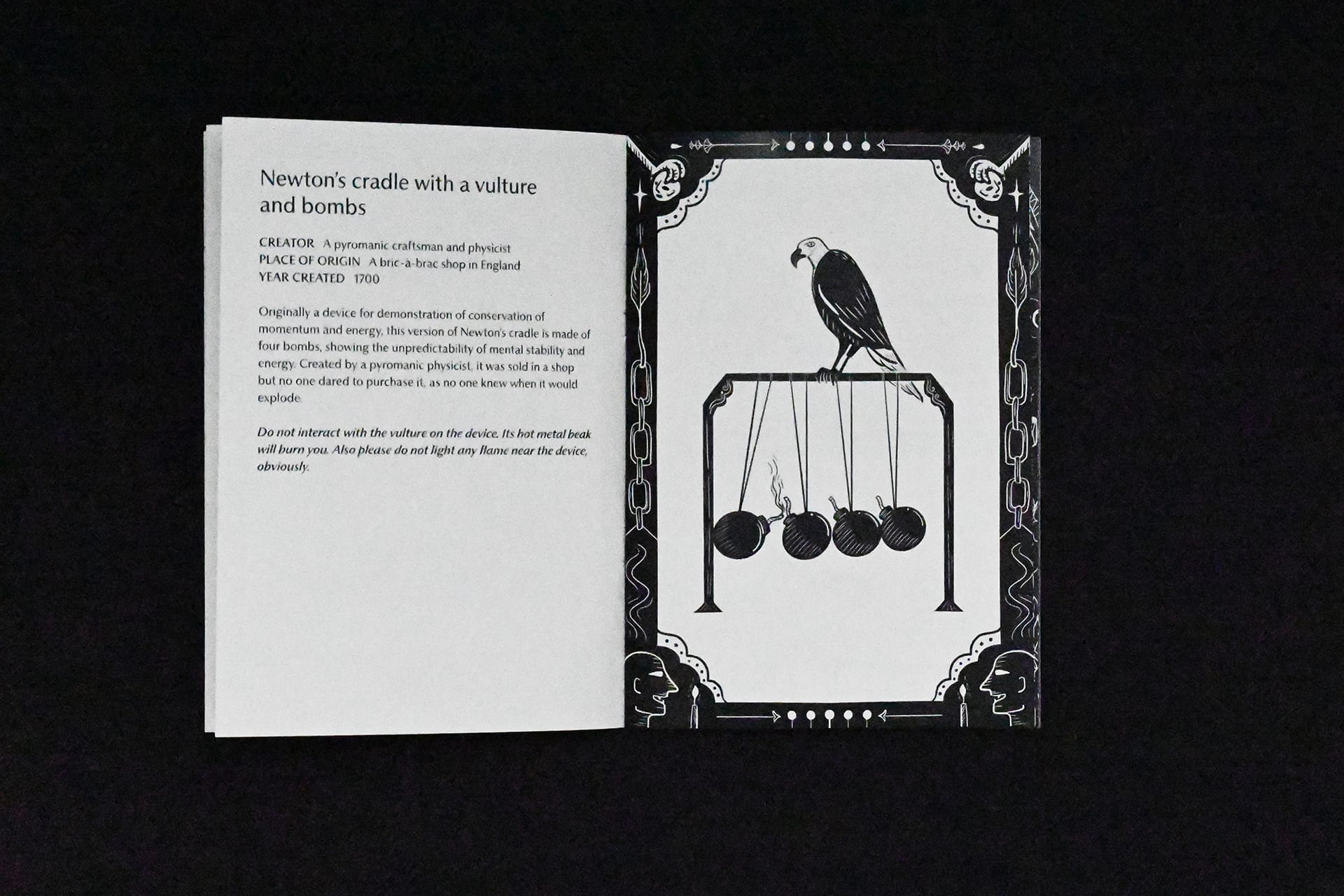
Newton’s cradle made of bombs
this device is supposed to include 5 spheres and demonstrate the conservation of energy, but this version, created by a pyromanic craftsman and physicist, only has 4 bombs, symbolising the unpredictability of intense emotions of trauma. A vulture coldly guards the device, depicting the traces of perpetrators in the victim's mind even though they no longer are in their life.
A note on the symbolism of the artifact: the number of bombs in the Newton's cradle is not designed to be 4, it was in fact a human mistake. However, as an AI tool reviews the work, it interprets the mistake as a deliberate move, which reinforces the nature of unpredictability of trauma. Logical and apt, the explanation is adopted. This case implies that meaning is not solely fixed at the point of creation but can be constructed retrospectively, often through serendipitous interpretation. This points to a potential modality of human-machine collaboration in the interpretive process, where machine-generated pattern recognition is curated and validated by human critical judgment.
Nautilus shell with mouths and a head
there's a popular saying that when held close to the ear, one can seemingly hear the voice of sea (actually the ambient noise) from a seashell. Inspired by the folk myth, 8 mouths and a head with no mouth are added to the nautilus, which symbolizes the intrusive dark thoughts / flashbacks of the trauma, yet the person suffering can't even scream back.
Metronome with a dancing ballerina
metronome is a device that produces sound at regular interval, and the user plays music according to it. Borrowing the idea of a music box, a ballerina that dances to the beat is added. Designed by a pianist and composer with OCD, it shows the unconsciously compulsive nature of following self-sabotaging behavioral patterns that stems from the trauma.
A dagger with blade as the handle
originally the weapons help one defend themselves when in danger. However, created by a blacksmith with self-destructive tendencies, this version's handle is made of blade, which means the user will hurt oneself even when they can defend themselves from external danger. This represents the victim relying on a specific defense mechanism to cope with the emotions / event, even if they deep down know it hurts them.
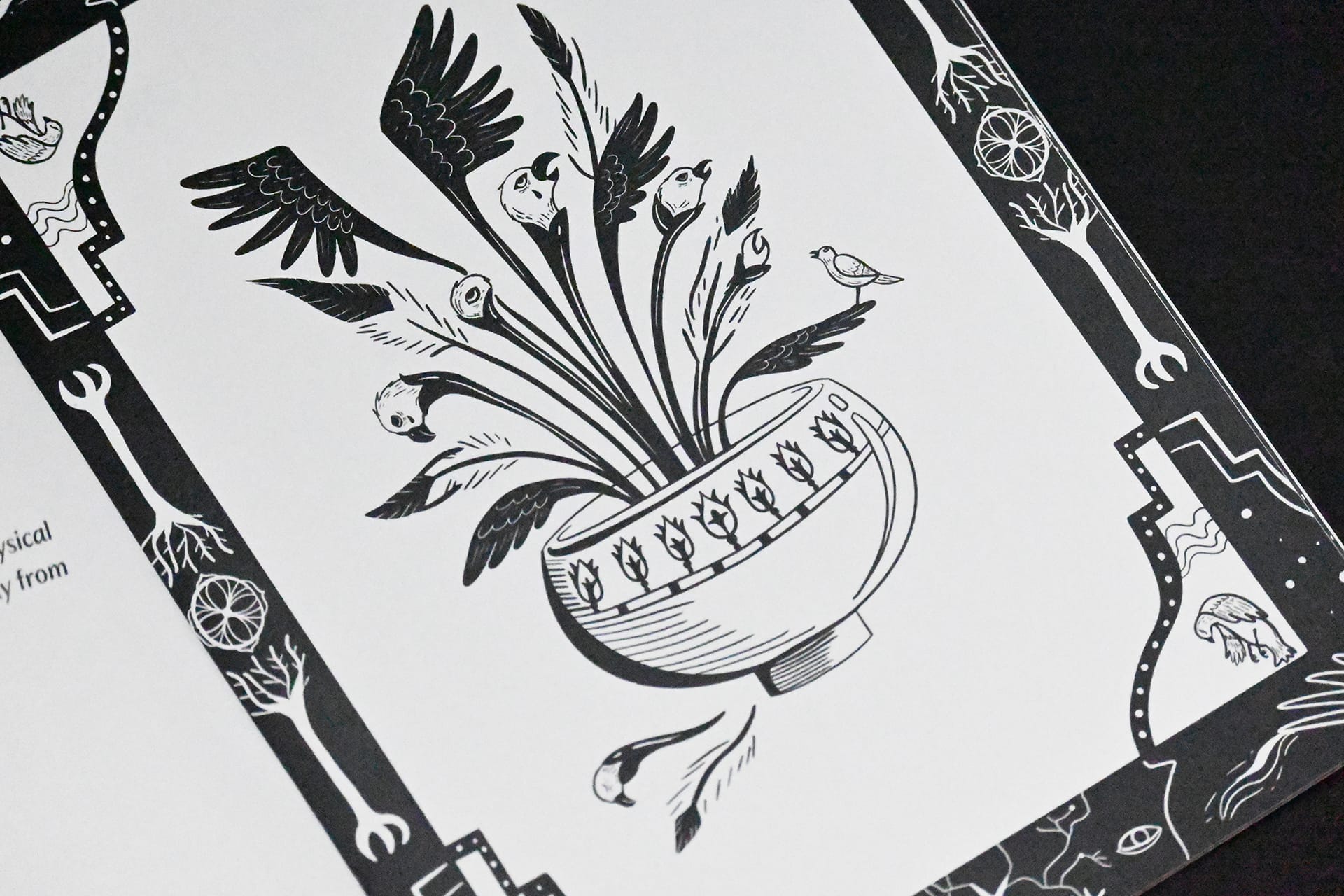
Potted plant that sprouts eagles
this is an irony inspired by the plant birds of paradise. Named as ‘eagles of hell’, the plant grows eagles’ heads and wings separately. Eagles are symbols of freedom, but now they can only weep and be trapped in the potted plant til death, because they are born this way. This represents the transgenerational trauma, when parents / a group of people have unresolved issues / unhealed collective trauma, the harm may affect their children.
Chapter 3
The third chapter (realization and healing) is presented in 3 objects, i.e. burning poppies, a mirror that reflects the viewer’s skeleton, and a kaleidoscope:
Self-burning poppies
the flaming poppies drip black gasoline and the fuel strengthens the flames. It’s a romanticization of self-destruction and beauty, particularly in an artistic context. Seen as harmful, it reflects society's obsession with emotional pain and beauty as a duo. It can also be interpreted as emotional sublimation through art.
Mirror that reflects the viewer’s skeleton
designed by a physicist with depression, this mirror doesn’t show the flesh of the viewer, but the skeleton of them like an X-ray scan. It signifies that the victim gained enough courage to face the trauma and realize its implications and harm.
Kaleidoscope that works in the dark
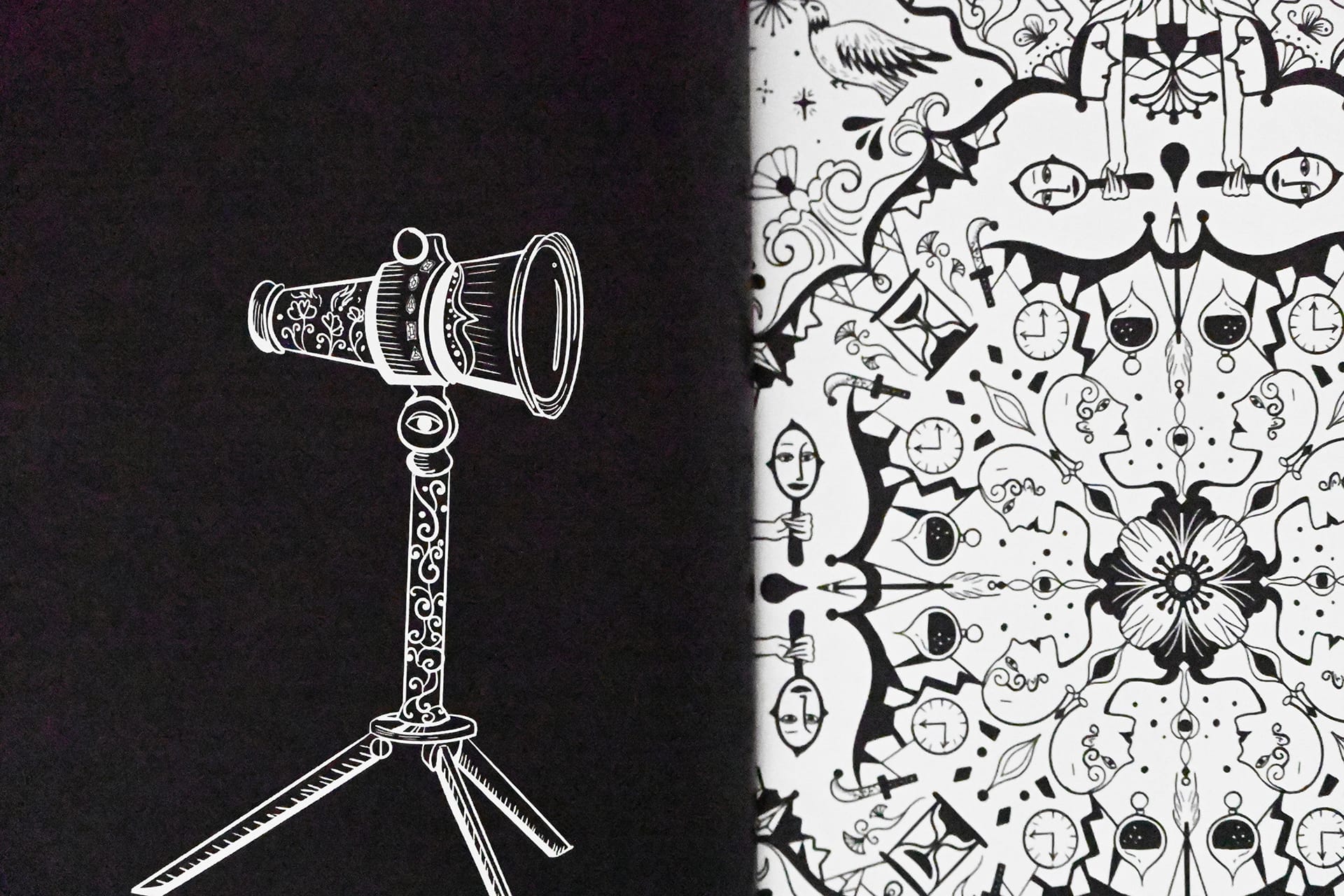
kaleidoscope is an optical device that creates beautiful patterns. But in the zine, it works without light and the cracks form the patterns, designed by a craftsman with bipolar 2 disorder. It symbolizes the victim overcoming the trauma, even if the trauma did change their perspective and damage is done. And the patterns created echoes with the previous objects – the eagles finally fly freely, the mirror again reflects the flesh and face of the viewer, the daggers now have proper handles, the stream of sand in the hourglass no longer forms an arrow… this represents the healing and recovery, though it is a long way and they can’t erase the past.
Final words
The Traum(a)’s Kunstkammer is an attempt to intervene societal discourses on trauma. It tries to let readers see trauma in an unflinching and direct manner. For survivors, the work recognises their unspeakable pain and recovery, a non-linear process demanding brutal honesty, is possible.